
Noise monitor dashboard – overview

Everyone encounters sound every day. It is only when that sound causes an adverse effect on a listener, such as annoyance, does that sound become noise. Noise is not always just about how loud the sound is, there is a complex set of factors that drive annoyance both based upon the noise itself and what that noise means to us. You can find out more in the following video:

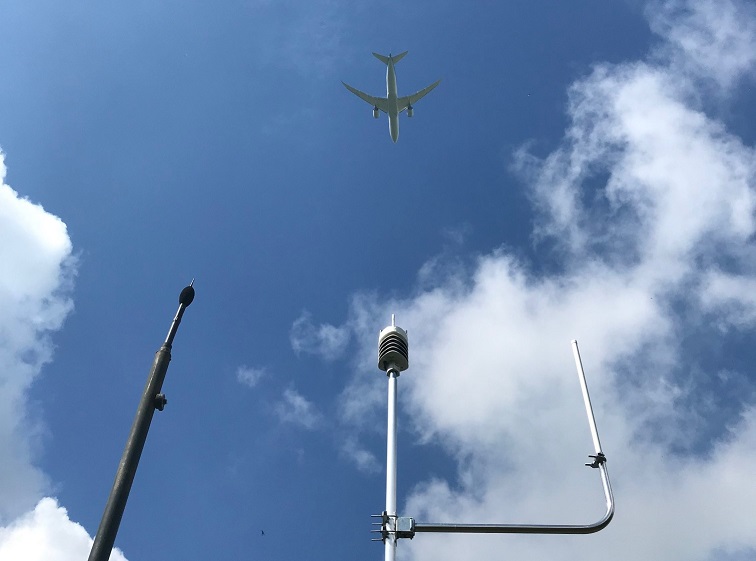
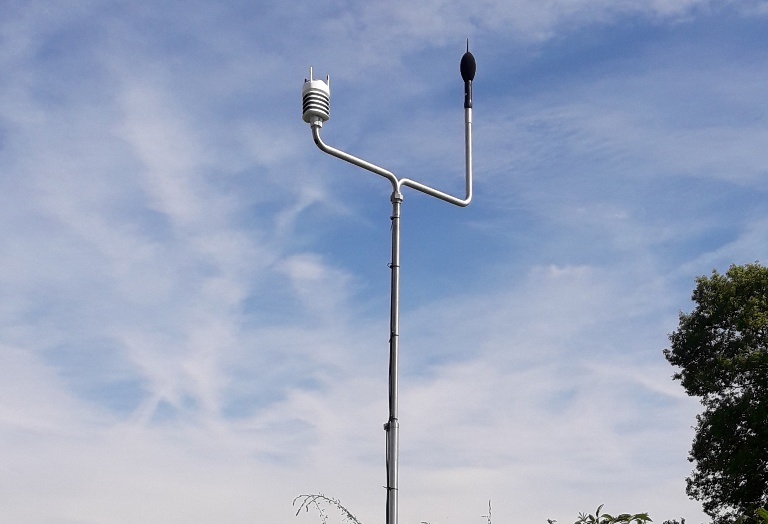
To understand the noise impact on the local community the airport has a number of fixed or temporary noise monitors deployed in the local area, generally under or near flight paths. The monitors detect and send the noise levels every second 24 hours a day, 7 days a week to a central system.

This dashboard presents an overview of the data collected by the noise monitors deployed in and around the London Gatwick area. If you select a single monitor, more detailed analysis is available.

A more detailed breakdown of for each noise monitor is available in the detailed dashboard.
Noise monitor dashboard – detailed

This dashboard presents a detailed breakdown of the data collected from our fleet of noise monitors. It only shows one monitor at a time, but you can choose your nearest monitor from the drop-down menu.

An overview of the data collected by all of the noise monitors is provided in our overview dashboard.

Noise complaints dashboard

This dashboard presents an overview of the aircraft noise complaints submitted to London Gatwick. All data is anonymised and is presented here to provide a summary of the data from areas around the airport:

Wind and runway direction

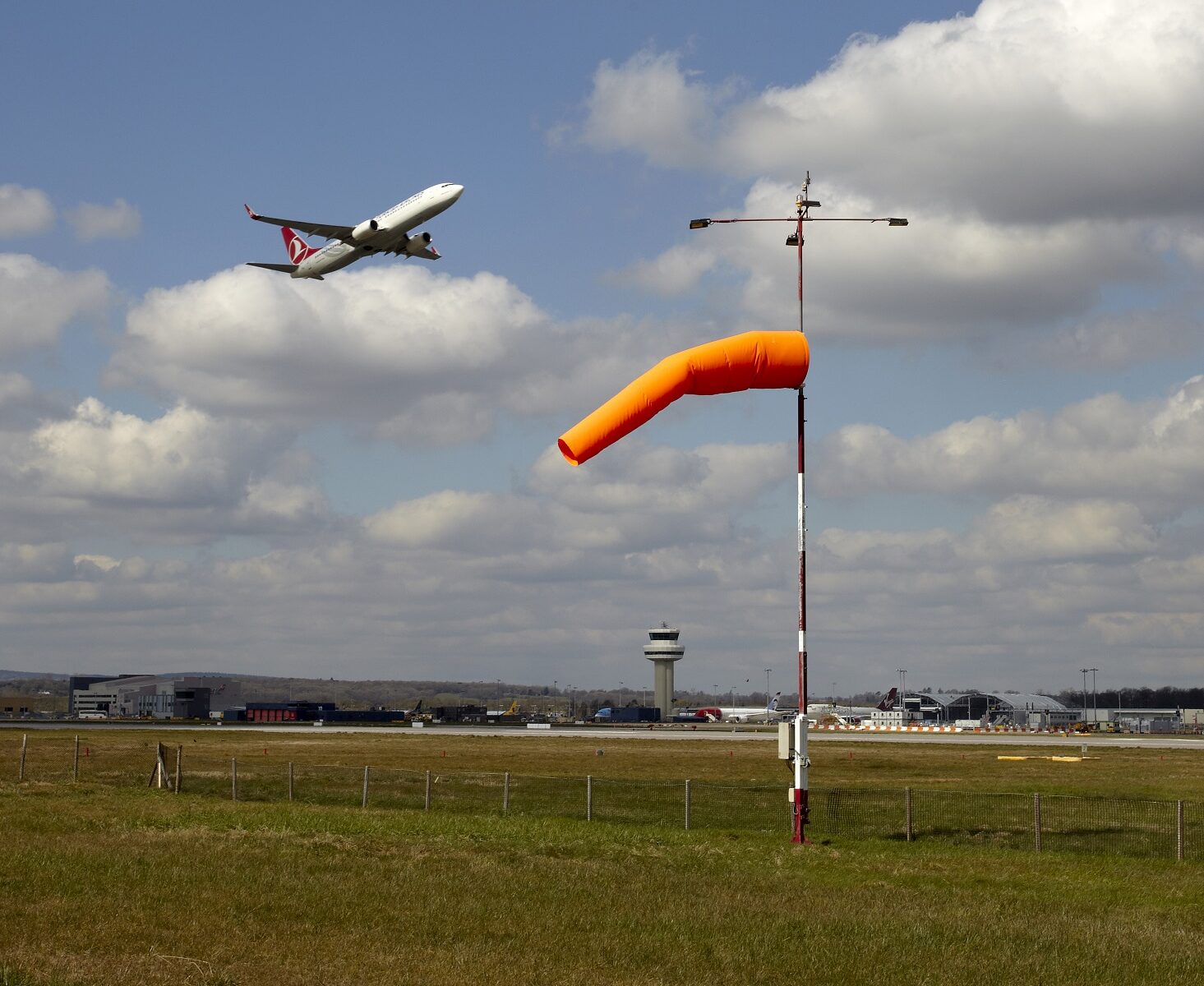
It is important for the safe operation of aircraft that they both land and take-off into wind. On take-off, this will reduce the ground speed required to produce the lift to get airborne. On landing, it will again result in a lower groundspeed which significantly improves the safety margins in this critical phase of flight.

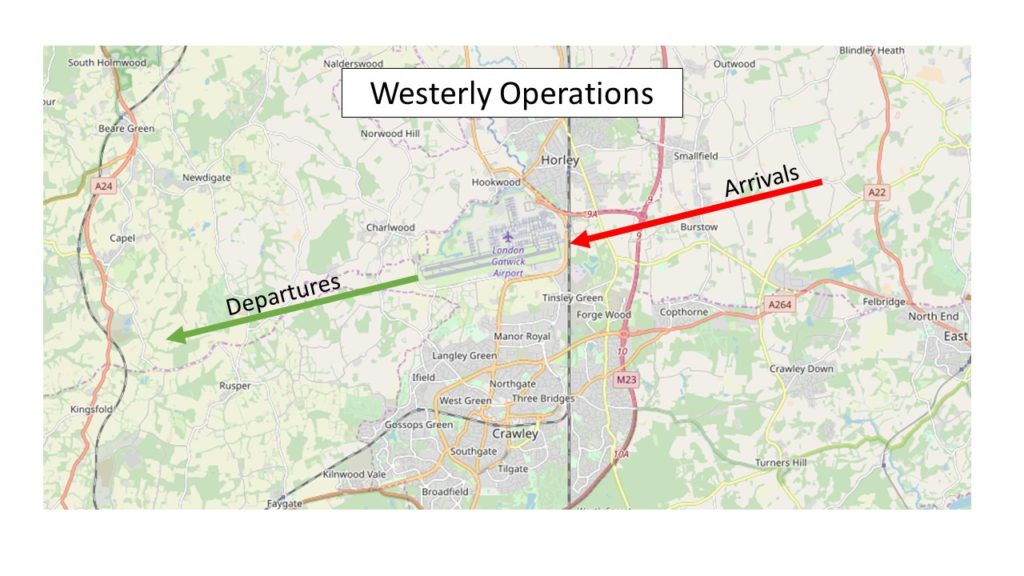
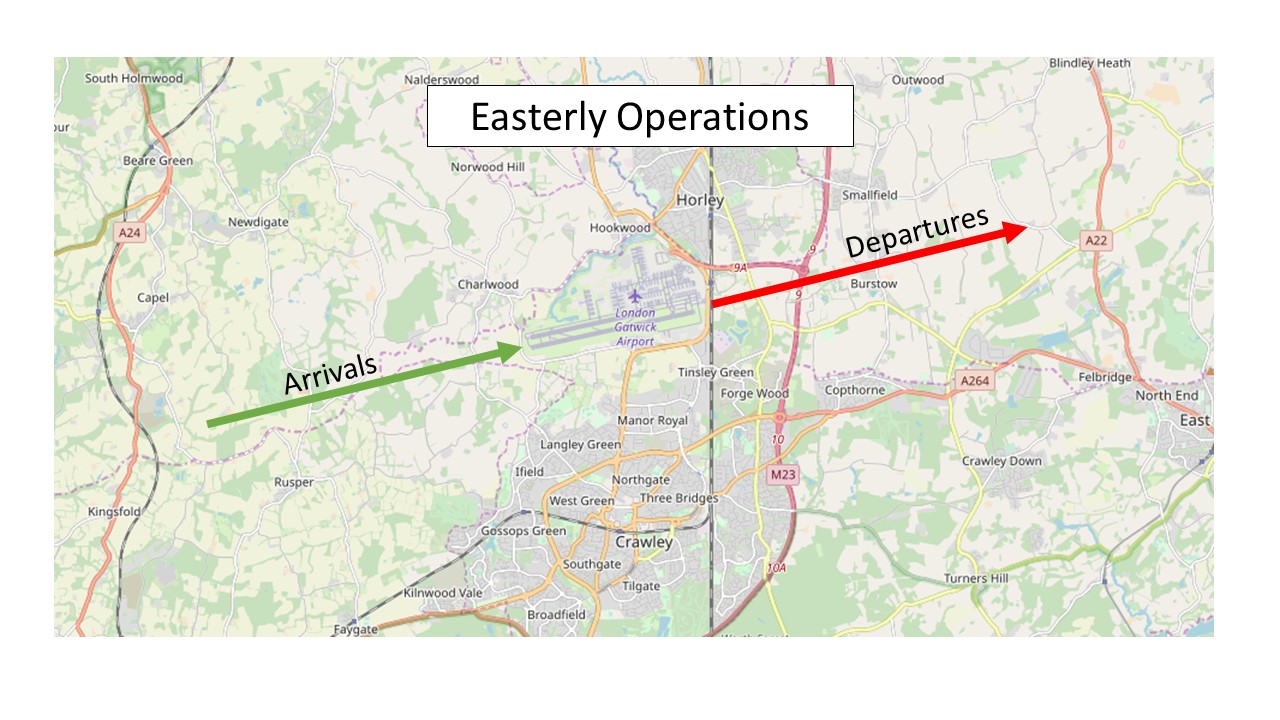
When the wind is from west to east, the airport will operate โ€œwesterly operationsโ€. Aircraft will approach London Gatwick from the east and depart towards the west. The opposite, โ€œeasterly operationsโ€, are used when the wind blows east to west. In recent years, on average around 70% of aircraft operations have been in a westerly direction and around 30% in an easterly direction. However this ratio does fluctuate, and weather conditions may mean prolonged periods of one operation or another.

The direction of operation is something which is considered carefully by Air Traffic Control in the interests of safe operations, giving consideration to wind on the runway and at 1,000ft and 2,000ft, the initial stages of take-off and the final stages of approach along with the forecast for the next four to six hours. The position is kept under review and any changes made in the light of all relevant factors at the time. The local weather forecast is not always a reliable indicator for what is happening at London Gatwick since it only reports the conditions at ground level.

The westerly and easterly operational directions are schematically outlined below:

Our current noise contour

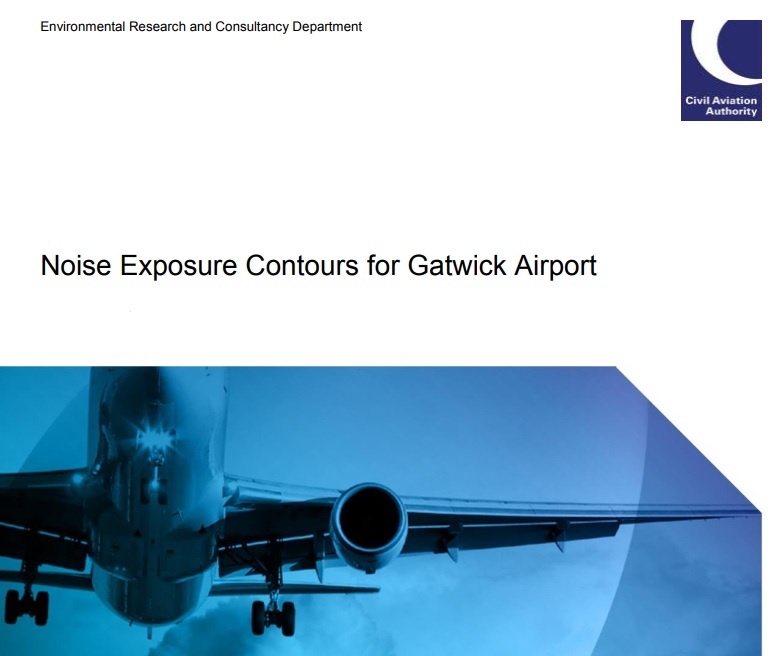
The following map shows the 2024 noise contour, produced by the UK Civil Aviation Authority (CAA). Using the slider on the map, the various contours can be viewed. The area of the 2024 summer day actual modal split 51 dBA Leq 16hr contour increased by 1.2% to 114.2km2 compared to 2023. In addition, the 2024 summer day actual modal split 54dBA Leq 16hr contour increased by 2.6% to 60.0 km2 compared with 58.5km2 in 2023. It should be noted that, in 2024, London Gatwick operated around 95% of the traffic compared to 2019, due to the effects of the COVID-19 pandemic on air traffic levels. Flight numbers have continued to increase year-on-year through the post-pandemic recovery which is why the contours have increased slightly compared to the previous year.

The full report from the UK CAA ERCD can be read in full here.


Arrivals and holding

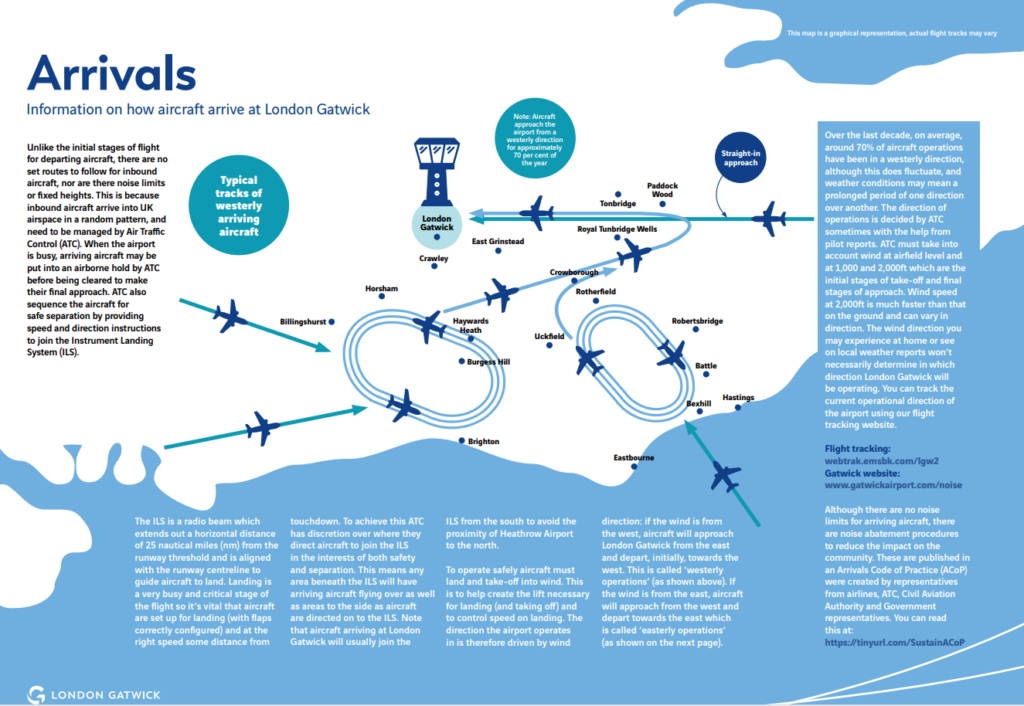
Arriving aircraft do not have defined routes to follow and are provided with instructions from Air Traffic Control who ensure the aircraft are safely spaced whilst being directed to land at London Gatwick. A number of factors affect where arrivals fly and the location of flight paths may vary significantly between different days and even during the day.

There are various noise abatement procedures in force to minimise the impact of arriving aircraft. One of the main noise abatement measures is Continuous Descent Operations (CDO), sometimes referred to as CDA (A for approach). By avoiding level flight segments and drastic speed reductions, the use of thrust and speed brakes is minimised which subsequently reduces noise emissions. Compliance with this procedure is monitored as part of our reporting.

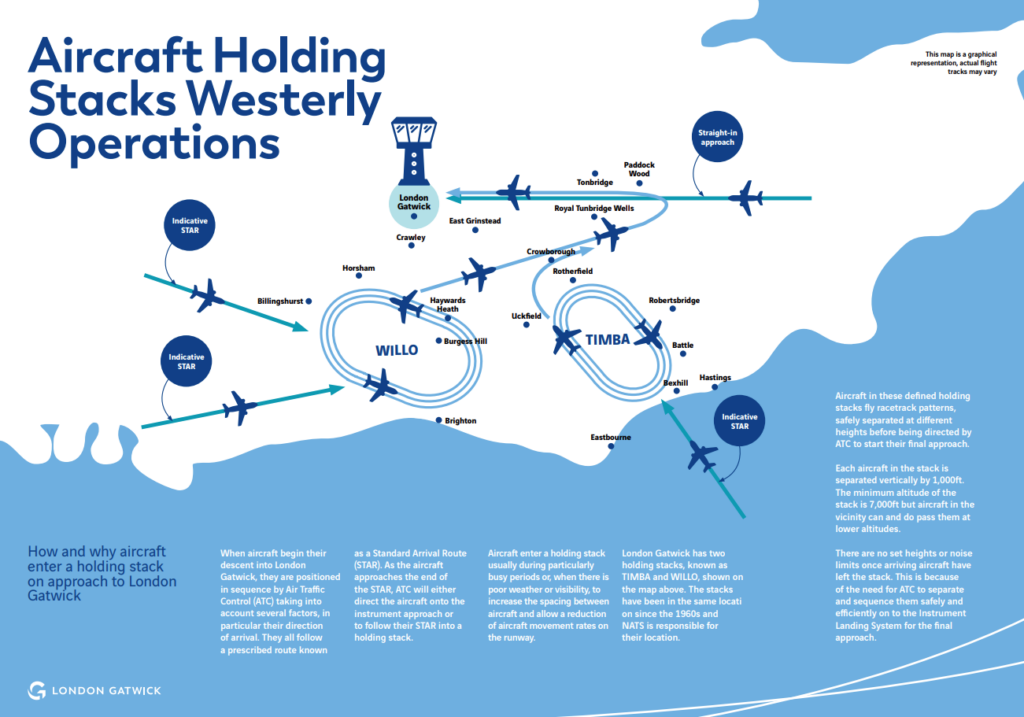
On occasion, often at busy times or during adverse weather, it will not be possible for aircraft to approach and land at London Gatwick without having to undertake short term holding. This takes place in fixed oval pattern known as a stack or hold. London Gatwick has two holding stacks; one called โ€˜WILLOโ€™ which is located west of Lewes and above Burgess Hill and the second, โ€˜TIMBAโ€™ is located above Heathfield. The stacks have been in the same locations since the 1960s. NATS is responsible for the location of the stacks and they cannot be moved without an airspace change and public consultation. The minimum altitude of aircraft in the stack is 7,000ft and is set to keep noise on the ground as low as possible.

You can find out more about how arriving aircraft approach London Gatwick by watching this short video or by downloading our information pack:


Arrivals and holding video:โ€‹โ€‹


Information packs:

Departures

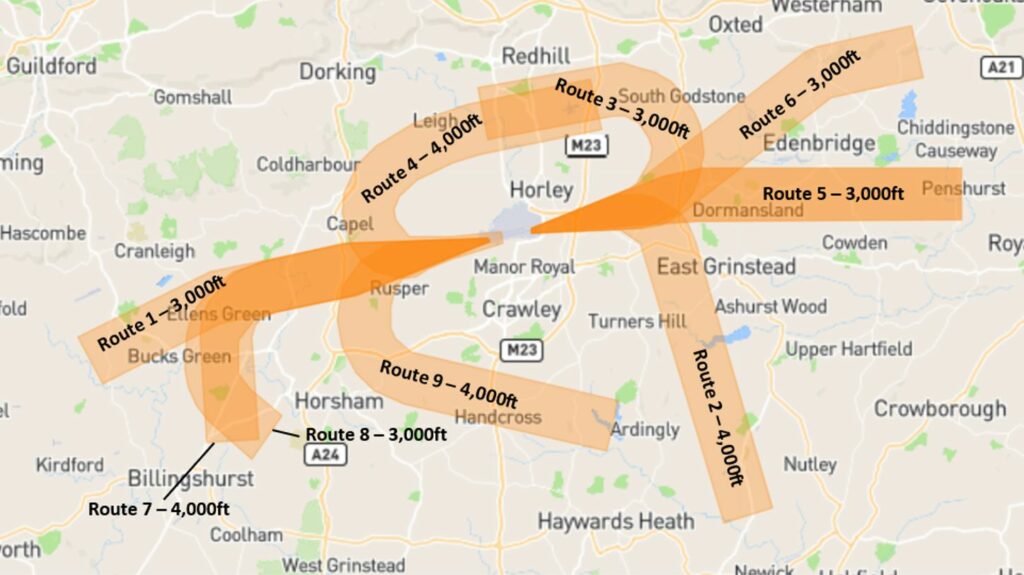
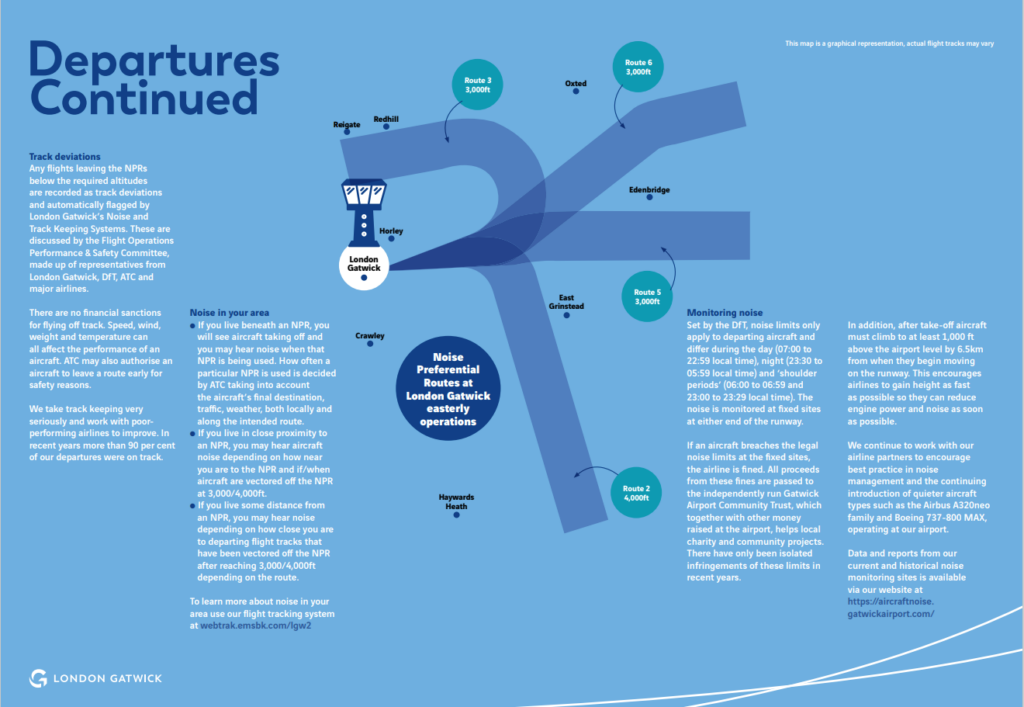
Departures are required to follow specific routes which were set by the Government back in the 1960s, these routes are called Noise Preferential Routes or NPRs. These routes are shown in the images below.

Pilots and Air Traffic Control are required to maintain departures inside the Noise Preferential Route until 3,000 or 4,000ft depending on the route in question. Once this altitude is reached, Air Traffic Control are able to direct aircraft off the Noise Preferential Routes towards their destination.

Our Noise Preferential Routes or NPRs:

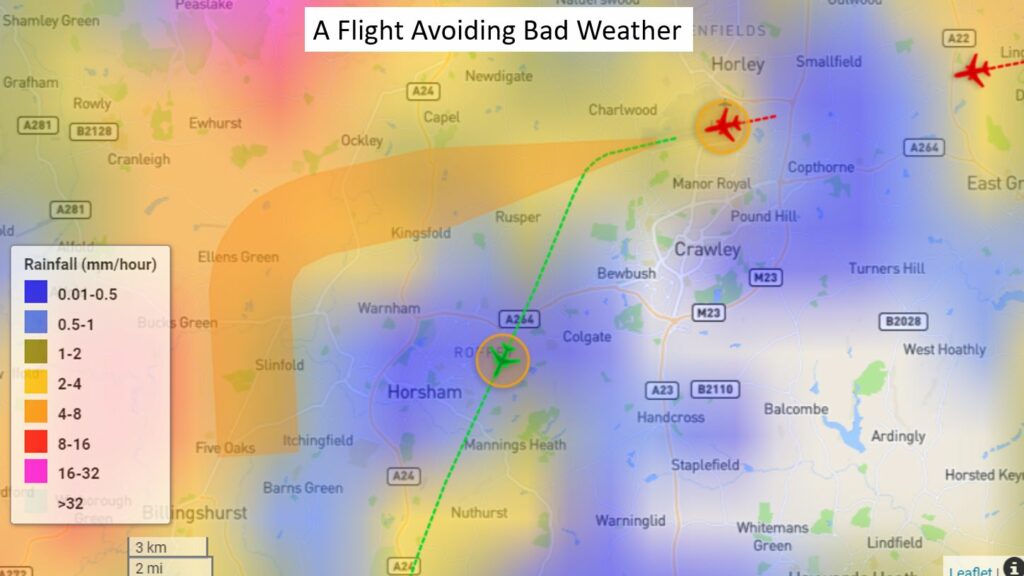
At certain times, Air Traffic Control may vector an aircraft outside the Noise Preferential Route to avoid adverse weather, such as thunderstorms, or other traffic in the vicinity. This may result in aircraft flying over areas they do not normally do. Our flight tracker has a rainfall layer that can show areas of intense weather than pilots often avoid.

An example of an aircraft avoiding bad weather:

Our Airspace Office reports tracks departing aircraft and reports on how may aircraft remain inside the Noise Preferential Route up to the minimum vectoring altitude. However, there are no financial sanctions against airlines that fly off track as there are many factors, including speed, wind, weight and temperature that can affect the performance of an aircraft.

You can find out more about how aircraft depart London Gatwick by watching this short video or by downloading our information pack at the bottom of this page.


Departures video:


Information pack:

Night flights

There is not, and never has been, a ban on flights operating to and from London Gatwick at any time of the night. However, in order to try to balance the interests of the all local communities and those of the airport users, for instance passengers, freight, time sensitive goods, aircraft emergencies and business, there are stringent restrictions and rules in place governing how the airport manages night time flights.

The Department for Transport (DfT) is responsible for defining these restrictions which are based on movements and quota count (QC). QC is a classification based on certified noise levels which allocates a certain amount of points (0-16) to an aircraft – the louder the aircraft, the higher its QC. The loudest aircraft types (QC8, QC16) are prohibited from operating during the night period (23:00 – 07:00) and QC4 aircraft may not be scheduled to operate during this time. During the night quota period between 23:30 and 06:00 the airport may facilitate aโ€‹ set number movements and quota count. The restrictions are divided into summer and winter seasons, which are in turn linked to daylight savings (BST/GMT). London Gatwick has an allowance of 11,200 movements and 5,150 QC in summer, and 3,250 movements and 1,785 QC in winter. These limits are designed to encourage the use of the quietest aircraft types within a limited number of movements.

The Airspace Office proactively monitors and works with airlines to manage their compliance with all Government restrictions and has no authority to alter these restrictions. All reporting is published on our noise website and through GATCOM and NaTMAG.

Go-arounds

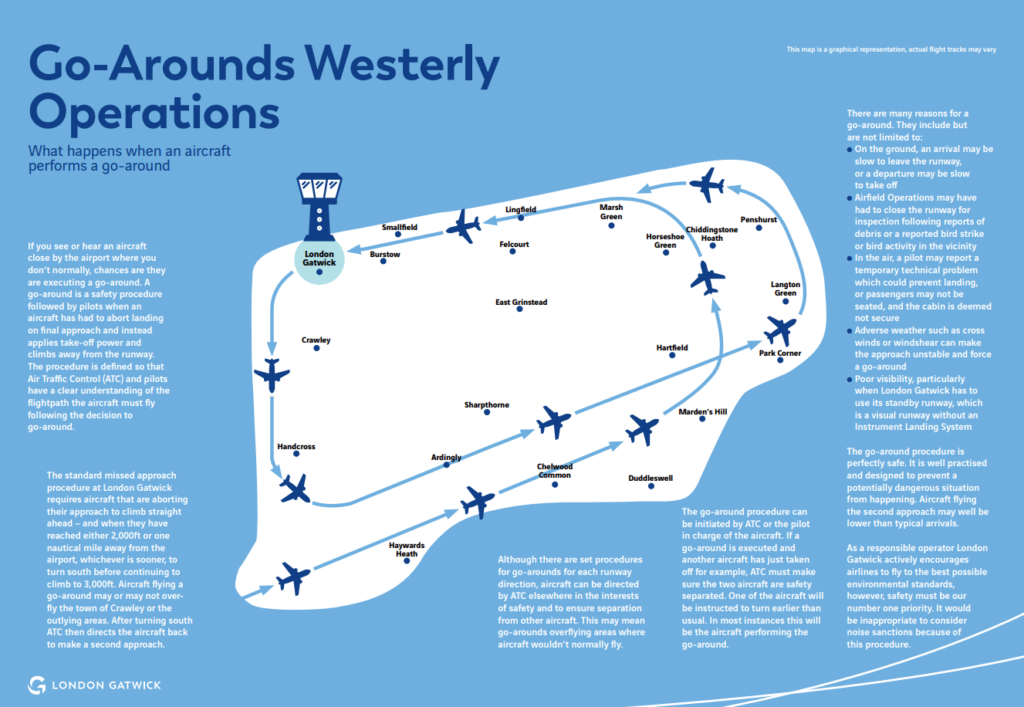
If flight crew or Air Traffic Control are not completely satisfied that the aircraft is positioned and configured for a safe landing a go-around is initiated. This is a safe and standard aircraft manoeuvre which may be executed at any stage of the approach and simply discontinues an approach to landing to ensure passengers and aircraft are not placed in potentially dangerous situations.

The go-around procedure involves aircraft turning south away from the airport before they are directed by Air Traffic Control back into the sequence for landing. This may mean that aircraft performing a go-around could overfly areas they do not normally do at potentially lower than expected altitudes.

Our Airspace Office reports on the number of go-arounds and the reasons why they occur, you can read these reports here.

You can find out more about go-arounds by watching this short video or by downloading our information pack below:


Go-around video: โ€‹โ€‹โ€‹โ€‹โ€‹โ€‹โ€‹โ€‹


Information pack:

Have traffic levels changed?

Air traffic flying to and from a local airport will vary in response to a wide range of factors including, but not limited to the local weather (on the ground and in the air), the volume of traffic, the make-up of that traffic (small, large, jet, propeller aircraft etc.) and what runway is currently in use.

The following interactive chart presents, for your area, a long term view of flights to and from London Gatwick and other airports.